SEO FAQ
SEO Copywriting for
Home & Lifestyle Brands
Straight-talking, no-jargon answers to get your site ranking for interiors and lifestyle businesses.
No. Whilst some agencies will try to blind you with jargon, the principles of SEO are surprisingly simple. It's search engines' way of helping users — matching them with the best answer to their query from the most trusted sources. When you optimise your website, you're making it easier for search engines to understand what you offer, so they can connect you with people actively searching for your products or services. The nuances matter — optimising for AI search, Google and snippets each works slightly differently — but they all rest on the same core SEO principles.
Is SEO Too Technical For Me?
SEO stands for Search Engine Optimisation. It's the process of optimising your website to improve its visibility on Google and other search engines, so the right people can find you when they're searching for what you offer.
Organic listings rank your site by matching your content to what people are searching for, selecting the best fit based on relevance, website authority, and ease of use. Your ranking position is influenced by a combination of technical and non-technical factors — covered in more detail below.
What is SEO?
Local SEO is the process of optimising your website and online presence to show up in location-based searches. When people search for a product or service 'near me' or in a specific location, Local SEO helps place your business in Google's results (known as the 'map pack'), which appear above traditional organic listings for many local queries.
Ranking is determined by organic factors such as relevance and website authority, alongside your business location, which is set through your Google Business Profile.
For service-based businesses, local SEO is where you gain the most traffic.
What is Local SEO?
AEO stands for Answer Engine Optimisation. AEO refers to optimising content for Google's Featured Snippets or People Also Ask, which appear above organic rankings in traditional search engines.
Featured Snippets directly extract content from high-ranking web pages, selecting content that best answers users' queries based on Google's own algorithm. Snippets suit question-based searches eg 'best green paint for small bathrooms'.
They signal trust to potential clients, which can influence future decisions when they're ready to take action.
What is AEO?
AIO stands for AI Optimisation. AI-powered search tools such as Perplexity and ChatGPT answer queries by pulling from trusted online sources. AIO is the process of improving your website content for inclusion and citation by these tools.
Getting cited is influenced by factors such as clear content structure and machine-readable labels (schema markup) as well as many of the principles that apply to traditional SEO, including authority, trust and expertise.
AIO doesn't replace SEO. It works alongside it.
What is AIO?
GEO stands for Generative Engine Optimisation. GEO and AEO are closely related and often used interchangeably, but there's a subtle difference.
AEO optimises content for any answer platform, including Google's Featured Snippets and voice assistants.
GEO focuses specifically on generative AI tools such as ChatGPT and Perplexity.
Both favour conversational searches — e.g., "what's better for rentals: laminate or vinyl flooring?" rather than just "laminate flooring".
What is GEO?
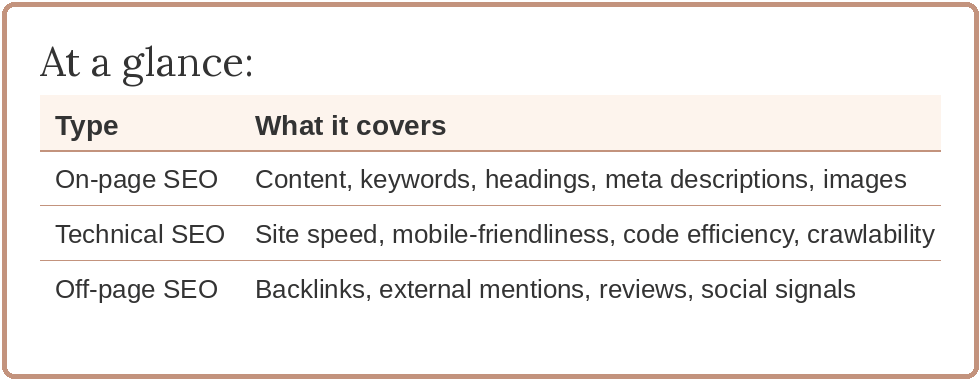
On-page SEO is the process of optimising the content and structure of your website pages so search engines can discover and rank them. It covers elements like content, headings, keywords, page titles, search result descriptions (meta descriptions), images, and overall page structure.
Done well, on-page SEO helps search engines understand what you offer — and connect you with people actively searching for it. It's the part of SEO within your control and a good place to start.
What is On-Page SEO?
Off-page SEO focuses on factors outside your website that influence your search rankings. It includes backlinks (from other websites to yours), online reviews, social media mentions, and brand citations. These signal to search engines that your site is trusted and authoritative.
Off-page SEO is harder to control directly — you can't force other sites to link to you — but you can earn it through quality content, genuine relationships, and consistently delivering content that people engage with. Strong on-page and off-page SEO work together to build long-term ranking power.
What is Off-Page SEO?
Technical SEO focuses on how your website works behind the scenes — fast loading, mobile-friendly display, and clean code that keeps your site running smoothly. It ensures search engines can easily access, crawl, and index your pages.
Other technical factors include site architecture, structured data (schema markup), secure connections and broken link management. While much of this is invisible to visitors, it's the foundation that determines your website's performance.
What is Technical SEO?EO?
Understanding Modern SEO
When your web designer says they've "included SEO," they may have only scratched the surface — which could explain why you're not seeing noticeable results.
Effective SEO works best when you understand:
*How your business operates
*Who your clients are and what they need
*Your unique selling proposition (USP)
*Your content pillars and messaging
*Your competitive landscape
*Your geographic location and local market
Once you've done the research, the rest relies on consistent application across technical foundations, content quality and user experience. Whether you opt for DIY or done-for-you, starting with the right foundation is the key to ranking well.

SEO FAQ’S
Straight-talking
-
Yes, significantly more — as the stats on my homepage show. But the volume difference isn't the only reason SEO outperforms.
SEO delivers long-lasting results, and you own your content outright — giving you full control. Social media requires constant posting and is subject to algorithm changes beyond your control. When the algorithm shifts, as it frequently does, your reach can collapse overnight.
Social mentions can boost your SEO authority, so it's worth having a presence. But for sheer volume of traffic AND lasting impact, SEO wins.
-
It's never too late. The rules are the same for everyone, whether you've been live for ten years or ten days.
Established brands benefit from high domain authority and accumulated backlinks, but they all started on an even playing field. When you're newer, it's easier to rank for niche topics, local searches and untapped keywords that established competitors have overlooked.
Focus on getting the foundations in place using real search data, and schedule regular SEO time for quick wins such as image alt tags.
-
Because SEO is competitive — think of it as a global race with new competitors constantly joining. Some improve their tactics with fresh content and quality links, moving forward; others fall back with broken links or harmful backlinks. Positions shift regularly, including yours.
Daily fluctuations are normal — even Google's algorithm updates can cause temporary movement. Focus on long-term trends, just as you would with an ISA investment. Consistent application of strong SEO foundations is what maintains rankings over time.
-
In a word, no. And neither can anyone else.
No legitimate SEO professional can guarantee specific rankings, because the competitive landscape is constantly evolving. Anyone promoting first-page results are making promises they cannot guarantee.
What I can do, and have done, is uncover the best keyword opportunities to rank higher — often on page one, sometimes on the top spot — against direct competitors. I'll focus on ranking opportunities that are realistically achievable in the shortest possible timeframe.
-
Less than you'd think.
Featured Snippets and AI Overviews now provide answers directly in search results, often without users needing to click through to a website. AEO (Answer Engine Optimisation) is the work of getting your content into those results.
The upside: when someone sees your name cited as the trusted source for an answer, you stay top of mind. The next time they're ready to buy a product or hire a service, your business is the one they’ll remember and search for by name.
Measure success by revenue, not just traffic.
-
SEO isn't a one-off task — it's an ongoing process. Competitors refine their content, and what people search for shifts over time. Add to that the occasional broken link or toxic backlink that needs fixing, and rankings you worked hard for can slip if not maintained.
As a rough guide: review your core pages every 6-12 months, publish fresh blog content regularly, refresh older blog posts yearly, and check your Google Business Profile and image alt tags every quarter. Large-scale reviews are worth doing whenever you redesign your website, launch new services, or see a sustained drop in rankings.Small, consistent updates beat long overdue catch-ups. As the proverb warns, ‘a stitch in time saves nine’.
-
All my copywriting begins with an in-depth SEO strategy aimed at identifying rankable keywords — so your website becomes a self-sufficient marketing tool. I optimise copy structure, fix broken links, and correct missing or poorly optimised title tags and meta descriptions. Keywords are carefully mapped so each page has a clear purpose — ensuring no two pages compete against each other. For larger websites, I’ll create a tiered structure that’s user-friendly, maximises sales and optmises SEO.
I'll also flag any technical issues, providing clear guidance for you or your web developer to address.
All these services are included free with website packages of four pages or more.
Note: image alt tags aren't included as standard, as many websites run to hundreds of images. They're covered in detail in my DIY SEO templates, or can be added as an extra service including update to the website.
Prefer to handle it yourself or in-house? My keyword packs were created for interior designers. Extracted from real search data and divided into handy clusters for residential, commercial and hospitality services — plus interior styles and design aesthetics, they are a valuable SEO tool for all your future copy.