Local SEO for Interior Designers: The Complete 2026 Guide
Ever wondered what we mean by Local SEO, how it differs from generic SEO and how to apply it to your website? In this comprehensive guide to Local SEO, we explore how to boost your online visibility with relatable language, tips for beginners and some quick wins. Divided into 24 easy-to-read sections with a handy table of contents for quick reference, it covers all you need to know to get started. Whether you're an interior designer, kitchen or bathroom designer, decorator or furniture retailer, local SEO is one of the most powerful tools you have for attracting clients in your area. This guide walks you through everything you need to know — from setting up your Google Business Profile to optimising your website — with practical quick wins you can start implementing today.
Local SEO Decoded: Attracting Design Clients in Your Area
If you're an interiors business looking to improve your local SEO, here's where to start. Search for local businesses online and scroll past the sponsored ads — you'll find a map showing up to three nearby businesses that match your search category (assuming enough local listings exist). These are known as the Map Pack, and each listing displays your business name, address and phone number — collectively known as NAP. The Map Pack appears above organic search results, with each business pinpointed on the map above.
Google automatically detects local intent in your search, even without a geographical location or the words 'near me'. On desktop, your IP address determines your location. On mobile, it uses your connection signal or location services if enabled.
Local SEO is what gets you into that Map Pack and pushes you higher up the local listings below it — one of the most powerful tools available to any interiors business looking to attract local clients.
Even if you're not in the top three, you're not out of the running. You may still appear in the Local Finder — the extended results page that opens when the searcher clicks 'View all'. Businesses here are listed based on a combination of relevance, proximity and overall local SEO strength, and results can run across multiple pages.
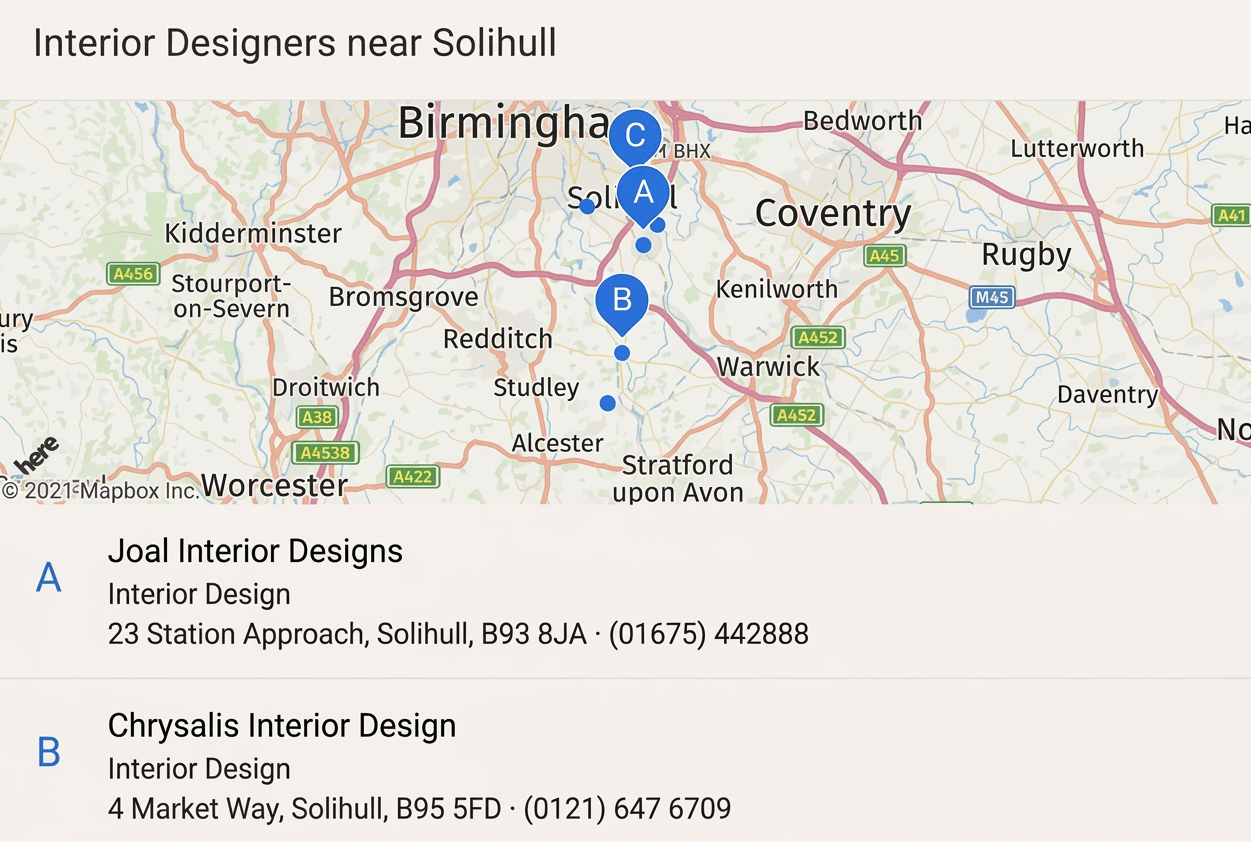
Being in the top three is where you want to be. It literally puts your business on the map — directly in front of clients who are actively searching for exactly what you offer.
Why Local SEO is Crucial for Interior Design Marketing

Local SEO is a must for local businesses such as interior designers, local estate agents and retail businesses
Why? Because local people visit shops on their doorstep and use local services, for convenience to save time and money. A high proportion of local marketing comes through local internet searches. The numbers are compelling:
1. Search behaviour "4 in 5 consumers use search engines to find information about local businesses"
2. Speed to action "76% of consumers who search 'near me' visit a business within a day"
3. Mobile conversion "88% of smartphone users who conduct a local search engage with a store within 24 hours"
How Local SEO Transforms Interior Design Businesses
The good news is that it’s free to register. The not-so-good news is that appearing on Google Maps is not an automatic process. Your website ranking is determined by several factors. Taking the necessary steps to optimise local SEO helps move you higher up the listing. However, it’s well worth the effort: businesses with complete Google Business profiles receive 7x more clicks than those with incomplete profiles and the top 3 results on Google capture nearly 69% of all clicks — making it clear that ranking well isn't just helpful, it's essential.
Appearing in Google's Map Pack gives you visibility above and beyond standard organic results. It’s SEO gold for local businesses.
Google Business profile allows business owners to link to automatic bookings with the Maps Booking API feature, adding a direct booking button, useful for local service-based businesses such as interior designers. For local home retailers, connecting their profile to direct retail ordering is an invaluable feature, greatly enhances click-through rates. It presents the client with a convenient, user-friendly experience that makes follow-through easy.
Local-based businesses must be ‘in it, to win it’. So how do you get in the game?
Claiming Your Google Business Profile: A Designer's Essential Guide
To start the process, the first task is to register for a Google Business Profile, formerly Google my Business.
Before registering for a Google Business Profile, you'll need a Google account if you don't already have one — which also gives you a Gmail address. You, or your web designer, may have set this up when you created a website. Typically this involves connecting Google Search Console and Google Analytics to monitor your website's traffic and performance. Keeping all your business activity under the same Google account makes everything much easier to manage under one Google admin account.
Once signed into your Google account, go to business.google.com to set up, claim, and verify your Google Business Profile. Follow Google's prompts to complete registration and verification. Be aware that Google now primarily uses video identification to verify your business, which requires you to record a short video proving that your business operates at the address you've listed — so be prepared for this next step.
When setting up your profile, you will be asked to choose a primary category. Choose one that best reflects your core service — for example, Interior Designer. You can add up to nine secondary categories to cover more specialist or niche services, which helps you appear in more specific searches and attract better-qualified enquiries. For interior designers, relevant secondary categories might include:
Residential Interior Designer
Commercial Interior Designer
Kitchen Designer
Bathroom Remodeller
Furniture Store
Lighting Store
A word of caution here before you get carried away: Google's own guidance favours choosing the fewest categories needed to accurately describe your business. Only select categories that genuinely reflect services you offer — over-categorising can work against you and risks triggering a profile suspension. Research local competitors to see how they choose to categorise their business, as this can guide your choices.
Include relevant keywords in your business description and services sections for maximum visibility, ensuring you maintain a natural flow, rather than forcing the keywords.
Worth noting for interior designers working from home: you have two options. If you meet clients at your home studio, you can list your address publicly and verify via Google's video identification process. This method requires you to show your workspace as proof of business at your home address. If you prefer to keep your home address private, you can register as a service-area business instead — this hides your address while still allowing you to appear in local search results for the areas you serve.
NAP Citations: The Backbone of Local Visibility for Interior Businesses
When setting up your Google Business Profile, you will be asked to provide information on your name, address and phone number (NAP data). This information must be both accurate and consistent across every online platform and business directory. You’ll need to keep a note of it to ensure it is identical on all internet entries. Google gathers information from various online sources to verify your authenticity as proof that you are who you say you are, and your website and business are bona fide.
The Importance of Consistent Nap Citations
The more consistent online NAP citations you have, the more you’ll gain favour with Google for local SEO as each entry is a further endorsement of your business legitimacy. So how do you go about gaining further entries?
Boosting NAP Citations with Effective Endorsements
Beyond your Google Business Profile, submitting your business details to other reputable online directories is one of the most effective ways to strengthen your local SEO. Every listing acts as a citation — a mention of your business name, address and phone number (NAP) across the web which boosts your local search ranking.
Start with the major general directories listed below, then work through industry-specific and professional organisation directories most relevant to your business.
A note on Apple Maps: it pulls much of its data directly from Yelp, so registering on Yelp significantly improves your chances of appearing on Apple Maps too — making it doubly important.
General Directories to List Your Business for Nap Citations
Bing for Business — Global bing.com/forbusiness
Apple Maps — Global mapsconnect.apple.com
Yelp — Global yelp.com
Yell — UK yell.com
Facebook Business — Global facebook.com/business
Interior Design Directories
Houzz — Global houzz.com
Houzz offers both free and pro subscription options and ranks highly for interior design. Registering with Houzz enables you to piggyback off its established SEO ranking position. Check out how to create a free business account on Houzz.
The House Directory — UK thehousedirectory.com
InteriorNet — UK interiornet.co.uk
Interior Design Directory — UK interiordesigndirectory.co.uk
The List by House & Garden — UK houseandgarden.co.uk
Porch — US porch.com
BuildZoom — US buildzoom.com
HomeBlue — US homeblue.com
Dexigner — US dexigner.com
Nextdoor — US nextdoor.com
Professional Organisations
BIID (British Institute of Interior Design) — UK biid.org.uk
SBID (Society of British & International Interior Design) — UK sbid.org
ASID (American Society of Interior Designers) — US asid.org
IDS (Interior Design Society) — US & UK interiordesignsociety.org
Social Media
Your social media profiles also act as NAP citations, so it's worth claiming your business name consistently across all platforms. This makes it easier for Google to verify your business — essential for local SEO ranking.
Instagram instagram.com
LinkedIn linkedin.com
Facebook facebook.com
Pinterest pinterest.com
X (formerly Twitter) x.com
Make sure your NAP details — business name, address and phone number — are identical across every single listing. Even small inconsistencies such as "St" versus "Street" can undermine Google's confidence in your business. It's good practice to save a master copy of your details to cut and paste across all entries.
For a comprehensive online presence, check out local community directories, Facebook groups focused on interior design and industry blogs in your area. Search online for "local business directories [your city]" or "UK business citation sites" to find region-specific opportunities.
Ranking Higher: What Gets Interior Designers into the Local Map Pack?
So how do you go about optimising your local SEO? Here’s the top three rankikng factors that determine your placement:
· Relevance
· Proximity
· Prominence
Let’s examine them in greater detail.
Relevance
How closely your business products and services match the user online search. This can be influenced by the inclusion of relevant keywords, helping Google identify what your business is about.
Proximity
Calculated by the proximity of your business to the search map directory, this isn’t something you can directly influence. However there are other merit-based factors that allow you greater control.
Authority
Assessed by business reputation and brand recognition, local businesses can successfully gain status through high-star local reviews.
Local SEO vs. Organic SEO: Key Differences
It’s important to understand that ‘local intent’ searches operate separately from organic searches and are determined by a different set of algorithms. For example, with typical organic searches, locality is not a ranking factor.
Generic SEO ranking uses the following criteria:
Relevance
The same criteria used for local SEO.
Authority
How reliable, credible and trustworthy the site is. Status is determined by factors such as backlinks acquired from credible sources, testimonials, credentials and blog content that evidence fresh and topical authority.
Efficiency
User-friendly factors such as well-structured websites, workable links, page load speed and mobile friendliness, keep readers on the page longer and improve your Google ranking.
It follows that websites that rank well for generic SEO often rank well for local SEO and are more likely to get cited on AI platforms.
Effective Keyword Research Strategies for Local Interior Businesses
Choosing the keywords that most closely match those of your potential customers can determine the 'relevance' ranking factor, so it's important to focus on conducting local keyword research. Although Google is getting better at detecting local search intention, it helps to include reference to geographical locations such as your local town and county or for US customers, city, state and metropolitan district. Sprinkle them throughout your key words and phrases and include them in your client case studies and target service areas for optimum results.
The importance of local search terms cannot be overstated. 'Near me' searches have grown by over 900% in the past two years, demonstrating how consumers increasingly rely on location-based searches to find businesses like yours.
5 Ways to Discover Popular Local Search Terms
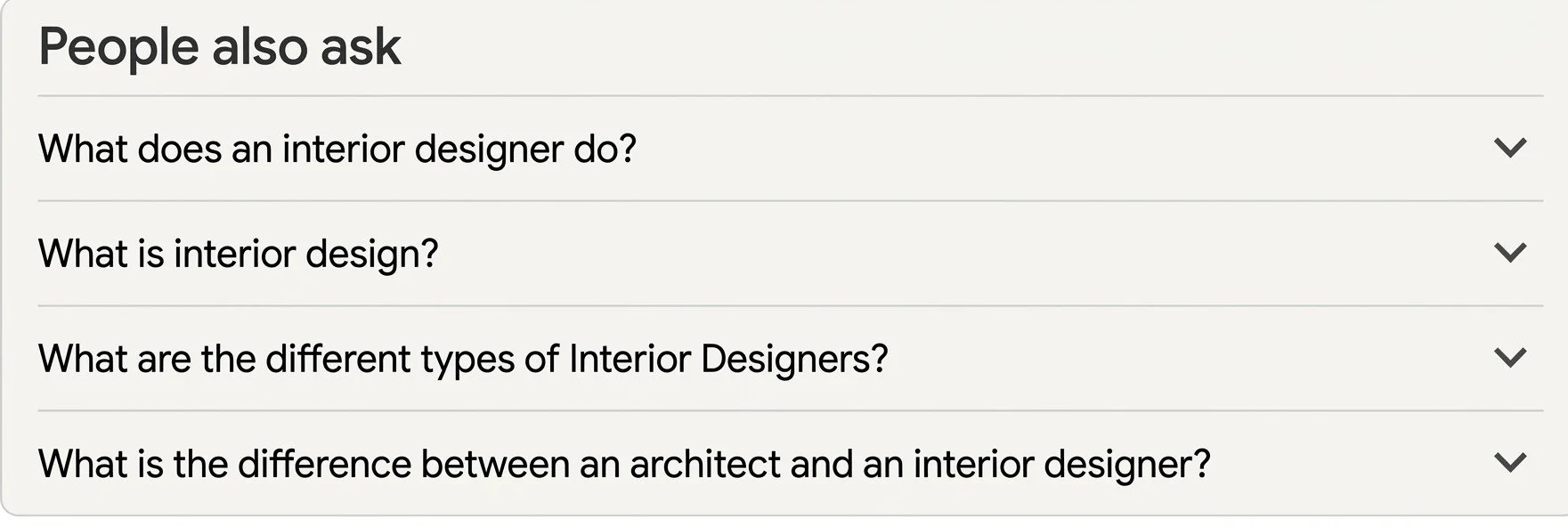
Check out the ‘searches related to’ or ‘related searches’ section on Google search for additional alternatives or the ‘people also ask’ section.
· Use Keyword planner tools such as SEMrush, Ahrefs, Uber Suggest or Google Keyword Planner.
· Check common terms and language used on forums such as Quora and Reddit and local community FB groups.
· Check out the category terms shown on your Google Business Profile when you type in related keywords.
· Analyse competitor’s keywords to determine their strategy and leverage the words they are using.
Keyword Research: Targeting Clients Seeking Interior Design Services
In an oversaturated market it's hard to rank for highly competitive phrases, so you need to get SEO savvy — particularly if you’re a new business or have a new website and want to rank quickly. Being strategic involves targeting keywords with lower monthly search volume, yet worthwhile traffic, that have a lower keyword difficulty scoring — making them easier to rank for. Find untapped potential in keywords that rank well against more established competitors. It’s easier to gain traffic from search phrases that have fewer online searches but less direct competition, than to attract visitors from keywords with a high number of searches but fierce competition from well-known competitors. The skill is weighing up the balance to find the optimal ranking ‘sweetspot’.
As a general guide, new websites should aim for a keyword difficulty score of under 30. Sites that are 6–18 months old with some initial traction can begin targeting scores between 30–50, and more established sites with a solid backlink profile can comfortably compete for scores up to 60. This figure will however depend on the popularity of your industry and may be lower for niche services. Always ensure there is enough search traffic to justify the choice. Keyword research tools such as SEMrush and Ahrefs can provide live search data.
New businesses should target lower search volume to gain initial traction, introducing higher search volume words as the business becomes more established. Start at a level where you stand a good chance of winning, build your confidence, improve your strategy and work your way up the ladder. Slow and steady moves the needle.
Need Help Finding the Best Keywords for Interior Designers?
Shop my keyword packs for interior designers. Divided into handy clusters for blog and website copy, each pack targets keywords that are easier to rank for, based on monthly search volume and keyword difficulty taken from UK search data. Use them for writing client case studies, your Google Business Profile and all your online website copy and blog content. Choose from Residential Services, Commercial and Hospitality Services or Interior Styles or a combination pack to suit your business. Request your free sample pack so you can see what’s inside.
On-Page SEO Tactics for Interior Design Websites
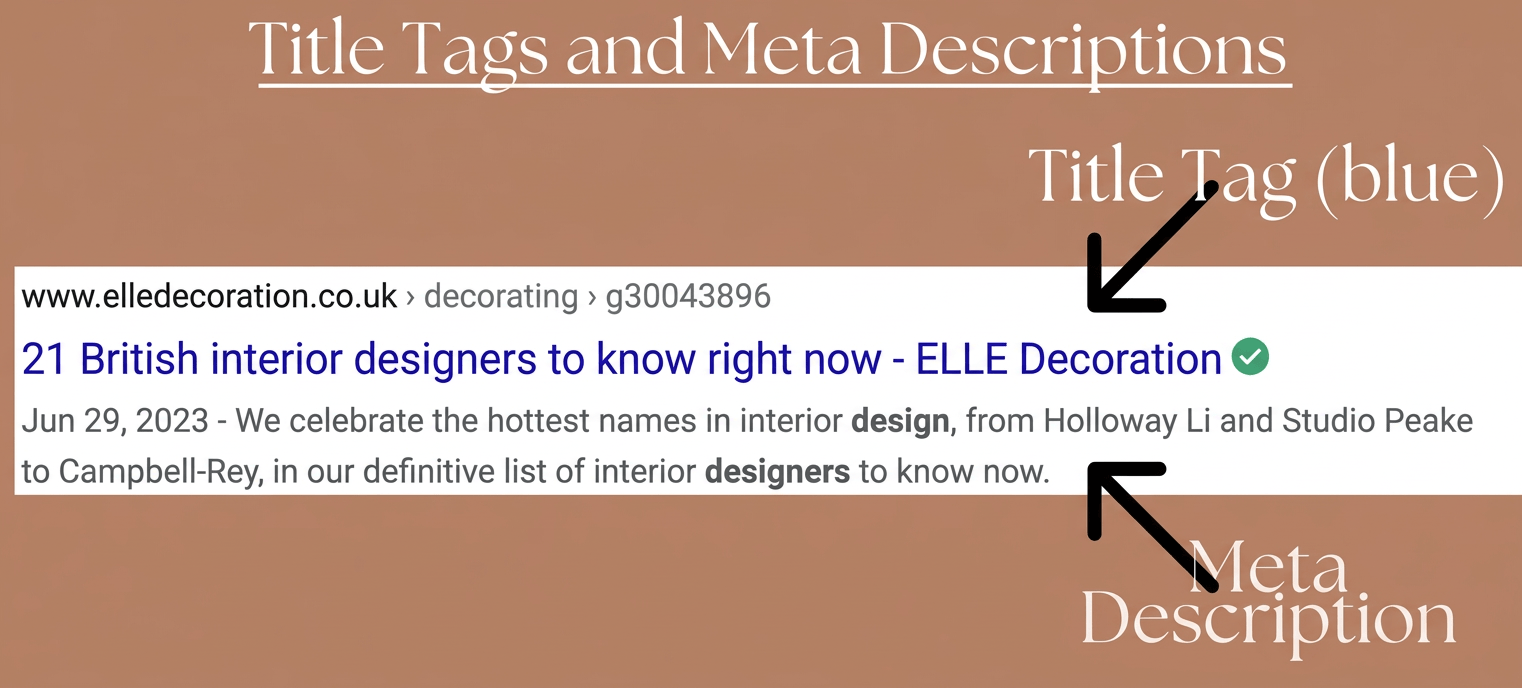
Title tags are key for Local SEO. Add location but don’t just bolt it on the end. Find creative ways to include it.
Title Tags
Title tags need to sound natural and enticing but keep them concise. Avoid keyword stuffing that sounds unnatural. If it jars when you read it, try again. Aim for a length of approximately 50–60 characters — to ensures your title isn't cut off in search results. Google's limit is based on pixel width rather than a fixed character count, as wider letters occupy more space than narrower ones. 50–60 characters is a reliable working guide for most title tags. Keep your core message within the first 50 characters and don’t exceed 65 characters — anything more risks truncation.
Be aware that Google now rewrites title tags around 76% of the time when it feels they don't accurately reflect the page content. This happens when titles are overly stuffed with keywords, too vague, or simply don't match what the page is about. If you want to stay in control of how your page appears in search results, stick to the basic rules.
Title tags appear in Google search results as blue clickable headlines — the link that takes you to the page. They are not the same as meta descriptions — the short paragraph of text that appears beneath the URL that tells you what the page is about. Want to see your current title tags? Head to Google and type site: followed by your domain (for example, site:janeeleywriting.com). You'll see how each of your pages appears in search results.
Meta Descriptions
Unlike title tags, meta descriptions do not directly determine SEO ranking. However, they are a useful tool for enticing traffic as they provide more information on page relevance and content and contain valuable keywords that may resonate with the reader. Think of it like a book blurb — a short, compelling summary that helps someone decide whether or not to buy the book or in your case, click through to your website.
Aim for between 150 and 160 characters for your meta description. Any longer risks Google cutting off your message mid-flow. As with title tags, place the most important information at the start of your tag. Bear in mind that Google will rewrite your meta description if it feels yours doesn't closely match the search query. Clear and relevant descriptions gives you the best chance of staying in control of your messaging.
Naturally target keywords, highlight benefits and unique selling points and where relevant, include your geographical location. A well-crafted meta description should feel like an invitation to view, not a list of keywords.
Image Alt Tags
Image alt tags may be small but their impact should not be underestimated. Often overlooked, they're one of the easiest SEO quick wins available to interior designers — but only if you follow the formula.
Alt tags serve two important purposes: they help search engines understand what your images are about, and they make your website more accessible to visually impaired users relying on screen readers. Both carry real weight.
Search engines use alt text alongside the surrounding page content to decipher images. Written well, they improve website visibility in both standard search results and Google Image Search — an additional source of traffic that many image-led businesses overlook.
The key to writing effective alt tags is to focus on relevant, information-rich content that uses keywords in context rather than cramming them in. ‘Keyword stuffing’, as that’s commonly referred to, leads to a poor user experience which can trigger spam flags with search engines. Aim to keep alt text under 125 characters and always write with a real person in mind — not an algorithm.
Plugins like ‘Yoast’ for Wordpress, can flag missing alt tags, and some can even generate them — but bear in mind that this produces generic image descriptions. Effective alt tags should target your business location, ideal client and competitor keyword gaps. That's the difference between an alt tag that fills the blanks and one that actively works for your SEO. It’s this level of detail that gives your business a competitive edge and it’s relatively easy to do.
Sound simple? It is, once you know the formula. Download my free 10-point alt tag checklist and start getting your image portfolio seen by Google.
Download my Free 10-point Alt Tag Checklist
Optimising Mobile Design for Interior Businesses
Most local searches take place on mobile, so it’s crucial to optimise for different mobile screen sizes. Use responsive design for compatibility. Ensure your font is visible, legible and easy on the eye, in terms of size, style and colour contrast against the background. It’s easy to fall into the trap of fancy design that detracts from easy reading. Remember many older people rely on reading glasses and sometimes they search without! It’s easy to get irritated if a website’s difficult to read and some will simply give up and move on to one that’s easier on the eye. Another way to optimise mobile efficincy, is by keeping your menu simple. Avoid pop-ups and flashing images which can be intrusive for mobile design.
Faster Loading Websites for Better SEO

Patience is key. In this digital age, people are short on it. They don’t have the time to wait for a page to load. Check your page loading speed to avoid visitors seeking a faster alternative.
There are a host of clever ways you can achieve faster-loading websites using a web designer or technical SEO expert. Here are some tried and tested methods:
· Choose a high-performance-optimised host for your website.
· Compress images using specialist software tools such as TinyPNG, Squoosh.app or Windows built-in Photos app compression.
· Aim for a file size under 200KB and maintain image resolution around 1200-1600 pixels wide.
· Ensure you use the correct file format when updating files and images. PNG: is best for images with text, providing higher quality, WebP: is a newer format using a smaller file size with good quality and JPEG: is good for photographs with a marginally lower quality for text.
· Avoid unnecessary page redirects. A redirect is a link that automatically sends a visitor to a different page — for example, when an old page has been moved or renamed. While sometimes unavoidable as your website evolves, too many redirects can slow down your website and confuse search engines. If you do need to use one, aim to remove it after about a year — this gives search engines enough time to recognise the new page and transfer any SEO equity from the old one. You may need to keep the redirect in place for longer if the old page is still receiving visitors from external websites or blog links.
· Use caching software to copy and store files, allowing quick access for returning visitors. Caching software temporarily stores website data. When someone revisits your site, the cached files load instantly instead of downloading everything fresh. This dramatically improves loading speeds. Caching software can be found on web browsers, servers and hard drives to speed up efficiency of data retrieval from memory, increasing overall speed load times. Examples include: Redis, Memcached or Varnish. Some caching software requires coding knowledge, so is best left to technical experts. User-friendly caching plugins are available for WordPress such as WP Rocket and WP Super Cache.
Local Link-Building Strategies for Interior Designers
As with generic SEO, the more referring domains you have, the higher your ranking authority. This refers to the number of live external websites linking directly to your website, proving the information you provide is useful. Here are a list of techniques you can use to build local links:

Host events at your premises for local community groups. Ask the host to link to your website’s Google map directions when they market the event online.
· Ask for referrals from complementary businesses you support, that align well with your own.
· Get featured in local newspapers, magazines and online publications.
· Support, get involved and sponsor local events and community activities.
· Volunteer or promote yourself for guest speaker spots on related podcasts or local radio.
Traditional generic link-building strategies also work to build links for Local SEO. This involves actively reaching out and acquiring back links by promoting the value of relevant statistics, reports or infographics from your blog posts or asking other sites to link to yours where you feel it adds value.
How to Track and Monitor Local SEO Performance
You can't improve what you don't measure. Regularly tracking your Local SEO performance helps you understand what's working and where there's room to improve. It also monitors how your rankings shift over time.
SEMrush's Map Rank Tracker is currently free for your first campaign and shows exactly where your business profile ranks in Google Maps. Other useful tools include BrightLocal, Moz Local, Local Falcon and Places Scout — all available in free or paid versions depending on the level of detail needed.
Make tracking a regular habit rather than an afterthought. Even one monthly check-in can reveal valuable insights and keep you ahead of local competitors.
How to Embed Google Maps for Optimal Local SEO
Embedding Google Maps on the contact page of your website optimises SEO whilst also making it easier for customers to find you. Check out Google’s embedding-map.
Geotagging: Putting Your Interior Business on the Local Map
Geotagging adds location data — in the form of GPS coordinates — to your photos before they are uploaded to your website, helping search engines understand where your business is based. Windows 10 and 11 both have a basic built-in option for this (via right-clicking a photo and selecting Properties > Details), though for a more complete solution, free tools like GeoSetter or PhotoLocatorare popular choices for Windows users. You can also use online tools instead of installing software.
Highlighting Local Landmarks: Local SEO Strategy
Here’s a list of local landmarks you can highlight on your website to improve your Local SEO:
· Unique amenities available at your business location
· Location-based products and services that include your business service area.
· Local events, history and landmarks
. Location-based design projects and case studies
· Local team members including bios and photos
Schema Markup: The Hidden SEO Weapon for Interior Design Businesses
A technical SEO expert can add local business schema markup to your website, which helps search engines read and understand your business data. Several tools can do this for you, including Rank Math for WordPress. Structuring your data helps Google understand what your page is about, which improves your visibility and click-through rates. Google may also choose to enhance your listing with rich results — such as star ratings, opening hours, and pricing — making it instantly stand out from competitors. Once considered optional, schema markup is increasingly regarded as an important part of any local SEO strategy. Several tools can do this for you, including the free version of Rank Math for WordPress — making it a great option for interior designers just getting started with local SEO.
Enhancing Local SEO Through Google Business Reviews
Reviews matter. Clients read these before deciding whether or not to buy from you, appoint your services or check you out. They’re a powerful endorsement for potential customers who want to know how others rate your service.
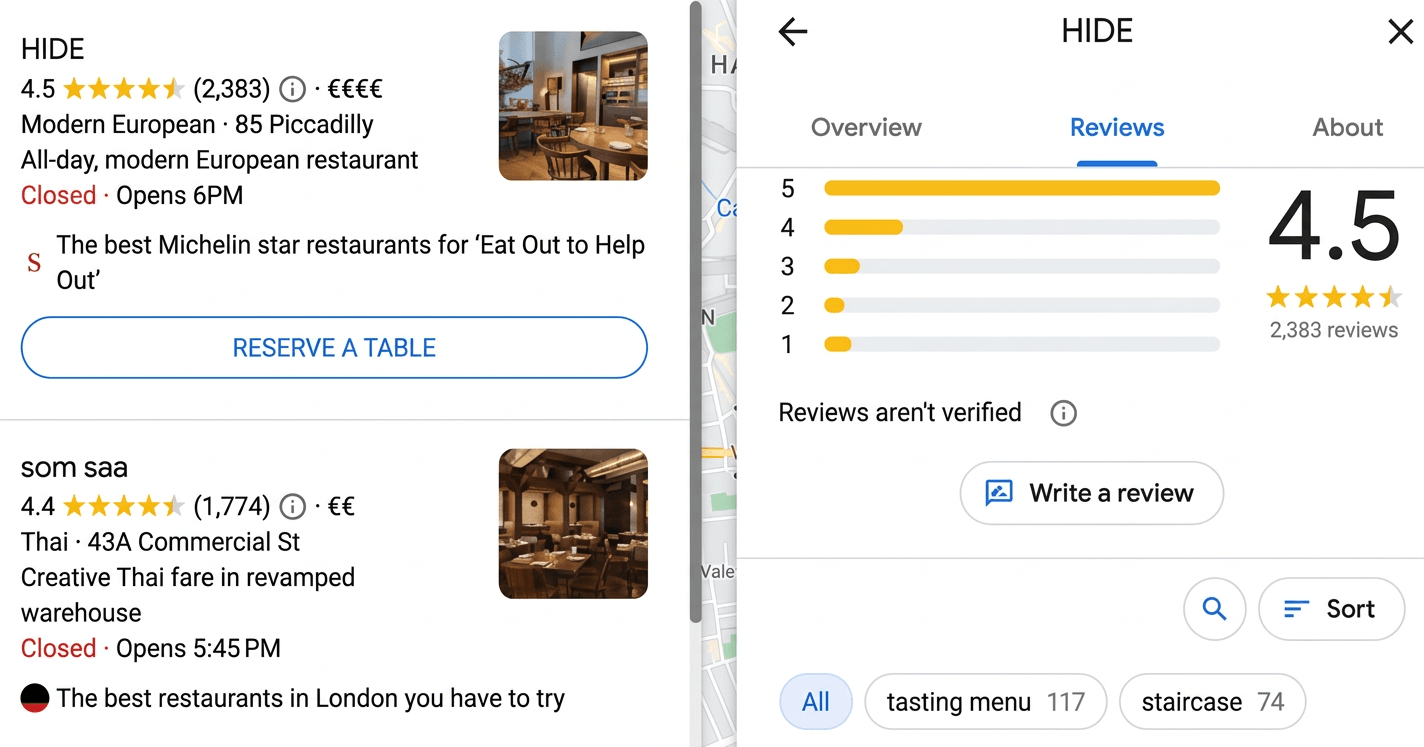
Searchers will prioritise high volume, good quality, up-to-date reviews and highly starred ones that exceed their competitors. So don’t forget to ask for them!
· Always proactively ask for Google reviews.
· Make it easy for clients by giving them a shareable link. (Click ‘Ask for Reviews’ in the edit section of your Google listing).
· Timing is everything - ask when the client has received good service from you and experienced a positive interaction.
· Follow up if you need to. People lead busy lives.
· Always take the time to appreciate good feedback to foster loyalty.
. Monitor reviews regularly. This enables you to respond quickly, professionally, and positively, mitigating any damage from unjustified comments should you receive a negative review.
. Respond using popular keywords to optimise your Google Business Review for searches, based on your key core services. For example, ‘Thank you for your kind words about our interior design services. We enjoyed working on the spatial design planning for your contemporary kitchen, creating bespoke designs to suit your lifestyle.’
Optimising Your Interior Design Google Business Profile
Include keywords in your Google Business Profile, consistent with your website copy, to strengthen SEO, keeping the flow natural.
Once established, don’t neglect your Google Business Profile. Regularly update it with photos, business opening hours and posts about your latest news, events and special offers.
Content Marketing for Interior Designers to Attract Local Clients
Last but by no means least, this ultimate guide to local SEO, would not be complete without mentioning content marketing to optimise your SEO through consistent blog content. As with generic SEO, consistent blogs, aligned with your keywords and core services, will optimise ranking. In moz.com/beginners-guide-to-SEO, content is ranked second most important in all SEO factors, topped only by Googlebot’s crawling and indexing of your site, without which your site would not be listed. Why so important? Because SEO blog content should include what your searchers are looking for (increasing search relevance through SEO keywords). To strengthen Local SEO, include local geographical keywords where relevant. For an interior designer, for example, this might include:
· A case study that focuses on interior design in your location
· A local event you have attended and supported
· A spotlight on your business and the benefits it brings to the local community.
Step By Step Local SEO: A Roadmap for Interior Design Businesses
So, there you have it, your ultimate guide to Local SEO.

If you’re feeling overwhelmed, remember, Rome wasn’t built in a day. Consistency builds over time.
Think of it as a framework. Once you have the plan, you can see which piece to start with and how everything naturally fits together. This guide will help you navigate the challenges along the way.
SEO results can take anywhere from 3 to 12 months to gain significant traction — but when it all comes together, the benefits are long-lasting and lucrative, driving organic traffic to your website and generating a steady stream of enquiries. You'll pick up small wins along the way, and the more you practise, the more it makes sense. It's a details game, and the buzz of seeing visible results only grows as you go.
We've already established how important online searches are for local businesses — and the data backs it up. 60% of marketers say that inbound marketing (SEO content and similar) is their highest-quality source of leads.
If you're an interior designer relying on local residential clients, or a home retailer relying on local trade, it's essential to prioritise Local SEO. And if you haven't yet claimed your Google Business Profile, now's the time to start.
Written by Jane Eley
Freelance Lifestyle and Interiors Copywriter
Found this blog useful? Why not bookmark it for future reference?
Jane Eley is a freelance copywriter specialising in interiors and lifestyle brands. She helps interior designers and home retailers attract more clients through strategic, search-optimised content. Enquire about working with Jane.
Related reading:
For a breakdown of the different types of content writing for interior brands, read Content Writing for Interior Design Marketing: 4 Ways to Boost Sales.